In today’s hospitality landscape, dinnerware plays a far more strategic role than ever before. Beyond functionality, it directly shapes brand perception, guest experience, and operational efficiency.
From material selection and color palettes to design details and sustainability, every element now plays a role in influencing customer perception and brand positioning.
This guide explores the latest dinnerware trends in 2026, with practical insights for restaurant owners, hotel buyers, and hospitality professionals—helping you turn trends into smarter sourcing decisions and real commercial value.
Key Takeaways
- Dinnerware is now a strategic tool for brand positioning and guest experience.
- Color plays a key role in creating atmosphere and strengthening brand identity.
- Porcelain, bone china, and stoneware serve different commercial purposes
- Durability is the new sustainability, reducing replacement costs and supporting long-term operational efficiency.
- Combining materials, colors, and textures delivers stronger visual storytelling and guest engagement.
- Choosing the right supplier is critical to ensure product consistency, scalability, and long-term supply stability.
What Are the Key Dinnerware Trends in 2026
From Uniform Sets to Mixed & Layered Styling
Traditional, fully matching dinnerware sets are being replaced by more flexible combinations. Mixing different materials, colors, and textures has become the new standard.
This shift creates greater visual depth while allowing restaurants to adapt presentation styles across different menus and dining scenarios.
Key shift: from fixed matching to flexible composition.
From Visual Appeal to User Experience
In the latest dinnerware trends of 2026, the focus has shifted from pure visual appeal to how tableware performs in real dining scenarios—both functionally and tactically.
Matte finishes, handcrafted textures, lightweight designs, and ergonomically shaped forms are becoming increasingly important in premium dining environments.
Key shift: tactility and usability take center stage.
Dinnerware as a Brand Expression Tool
Dinnerware is increasingly integrated into the overall brand system.
From color palettes and glaze finishes to shapes and forms, every detail is expected to align with the restaurant’s interior design and brand positioning. As a result, demand for custom and bespoke tableware continues to grow—especially among hotel groups and chain restaurant brands.
Systemization and Operational Efficiency
As the hospitality industry places greater emphasis on cost control and efficiency, dinnerware design is becoming more function-driven.
Stackability, modular combinations, and multi-functional usage are now key considerations. These features not only influence product design but also have a direct impact on daily operations in restaurants and hotels.
Based on these developments, dinnerware in 2026 is no longer a standalone product. It has become a strategic element that connects design, aesthetics, operations, and brand identity.
Color Trends in 2026 Tableware
Cloud Dancer: The New Definition of Elevated White
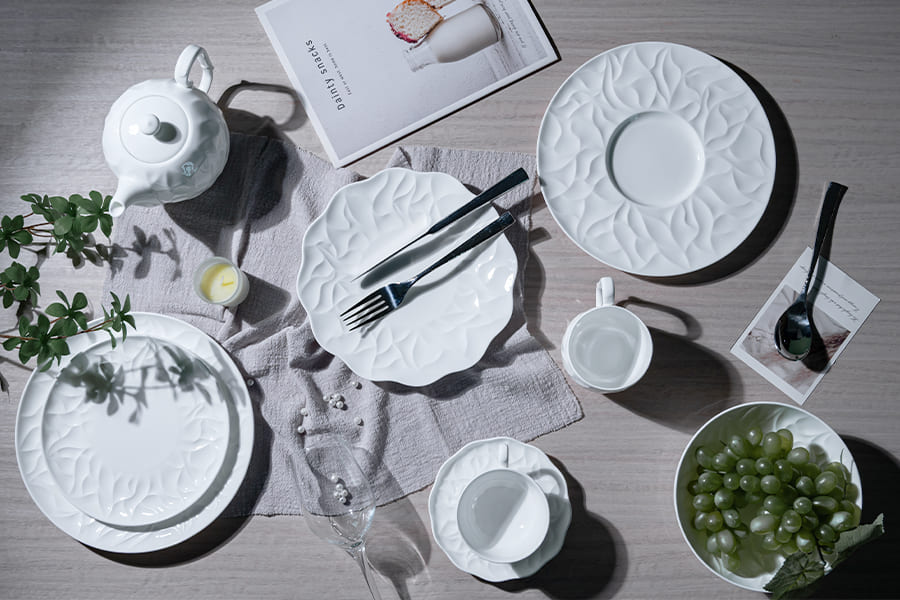
Unlike traditional stark white porcelain, 2026 favors a softer, warmer tone known as Cloud Dancer.
This tone features a soft, creamy warmth with subtle translucency, sitting between ivory and classic porcelain white.
In global procurement, this type of warm white is considered a “safe base color” due to its versatility and adaptability. It pairs seamlessly with various cuisines and plating styles while elevating the overall visual value of the table. For high-end hotels embracing quiet luxury, it has become a near-standard choice.
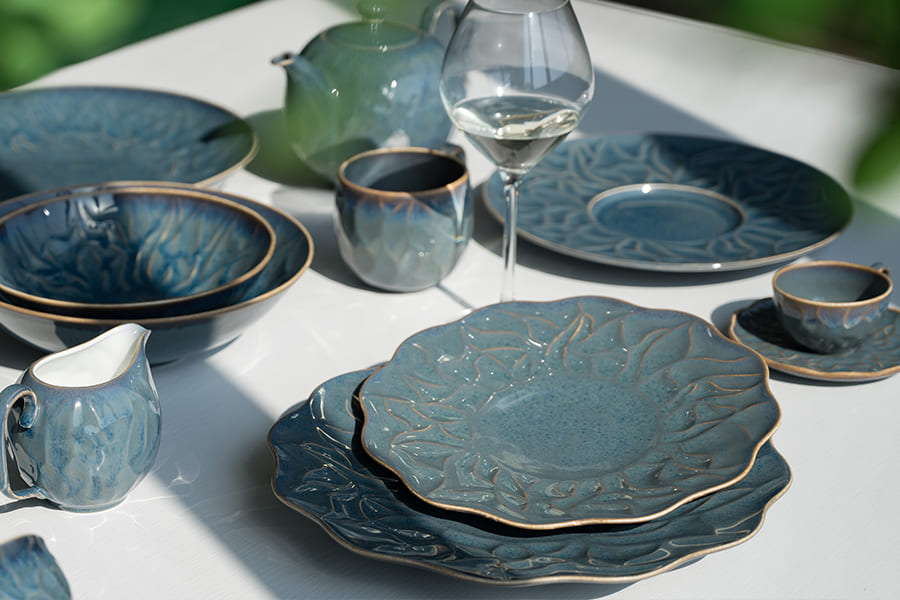
Transformative Teal: The Calm Power of the Ocean
Influenced by global climate awareness and ocean sustainability, Transformative Teal has emerged as one of the most commercially impactful colors of 2026.
Blending deep blue with organic green, this tone creates a strong visual effect. It is often paired with reactive glazes, handcrafted textures, or subtle wave patterns to add depth and a refined, contemporary aesthetic.
Commonly used in resort hotels, seafood restaurants, and evening dining environments to create contrast and visual depth.
Earthy Tones: The Visual Language of Sustainability
Earthy tones such as Sand Beige, Terracotta, Sage Green, and Warm Brown are widely used in farm-to-table and sustainability-focused dining concepts. They are particularly effective for restaurants that emphasize natural, healthy, and sustainable positioning.
They also integrate seamlessly with wood, stone, and other natural materials, reinforcing authenticity and warmth while supporting brand storytelling around sustainability.
Future Dusk: A Dramatic, Immersive Statement
Future Dusk sits between deep blue and dark purple, creating a deep tonal effect in tableware design.
It is commonly used in fine dining environments such as steakhouses and molecular gastronomy restaurants to enhance contrast and highlight plated dishes.
Color preferences vary by region, as shown below:
| Region | Preferred Colors | Design Direction |
| Europe | Bone White, Sage Green | Quiet luxury, matte finishes |
| North America | Amber, Warm Beige | Natural minimalism |
| Middle East | Black, Emerald, Gold | Luxury & contrast |
| Asia-Pacific | Cool Blue, Jade, Soft Purple | Calm, refined aesthetics |
These regional differences play an important role in global tableware procurement strategies.
Material Trends: Ceramic vs Porcelain vs Bone China
Bone China: Premium Experience & Brand Positioning
In modern dinnerware trends, tableware is expected not only to perform functionally but also to communicate a sense of quality and refinement—and bone china plays a key role in achieving this.
Containing bone ash 45%, bone china is lighter in structure and offers a degree of translucency, giving it a more delicate and refined appearance. Its signature warm ivory tone is softer than standard porcelain, making it especially suitable for high-end dining environments.
Beyond visual appeal, bone china enhances the tactile experience. Lighter and more refined tableware subtly elevates how guests perceive the overall dining experience.
From an operational perspective, its lighter weight improves service efficiency and reduces staff fatigue. Although the unit cost is higher, this investment is often justified in premium dining settings through enhanced brand perception and guest experience.
As a result, Bone china remains a preferred choice in fine dining and luxury hotels, valued for its refined appearance and lightweight performance.
At PITO, bone china collections are engineered to balance elegance with durability—ensuring they meet both aesthetic expectations and the operational demands of high-end hospitality environments.
Porcelain: The Industry Standard
Porcelain remains a cornerstone of Dinnerware Trends 2026 and continues to be the most widely used and reliable material across the hospitality industry. Its widespread adoption comes from its ability to balance durability, consistency, and cost efficiency.
Porcelain is non-porous and resistant to staining, allowing it to maintain a consistent appearance even under frequent use. This makes it particularly suitable for restaurants where tableware undergoes constant washing and handling. It is also highly compatible with commercial dishwashing systems.
From a business perspective, porcelain’s key advantage is long-term cost efficiency. While the unit price is moderate, its durability reduces replacement frequency, lowering overall operational costs.
For this reason, porcelain remains the preferred choice for chain restaurants, high-traffic dining environments, and hotel buffets, and continues to serve as the operational backbone in most restaurant tableware strategies.
Stoneware: Design-Driven Aesthetic
Stoneware stands out for its heavier feel and strong handcrafted character, offering a more natural and authentic dining experience. Its thermal properties also make it well-suited for serving hot dishes.
The three core ceramic materials can be compared as follows:
| Material | Best Use | Key Value |
| Bone China | Fine dining & luxury hotels | Lightweight, premium presentation |
| Porcelain | High-volume restaurants | Durability and cost efficiency |
| Stoneware | Concept-driven dining | Visual identity and texture |
Each material serves a distinct operational and brand positioning need in hospitality environments.
Sustainable Tableware: Why It Matters for Restaurants
From a Consumer Perspective: Sustainability Influences Dining Choices
Sustainability has expanded beyond food sourcing to become a defining factor across the entire dining experience—including tableware.
This shift is especially visible on social media platforms such as Instagram and Pinterest, where content around “eco-friendly dining” and “sustainable tableware” continues to grow. Sustainable table settings are becoming a new visual and lifestyle trend.
As a result, tableware is no longer just functional—it has become an extension of brand values.
From an Industry Perspective: Sustainability as a Procurement Standard
Sustainability has become a key consideration for many hospitality groups and procurement teams.
With the advancement of global ESG policies, international hotel groups such as Hilton and Marriott have incorporated environmental footprint requirements into their procurement standards.
As a result, leading tableware manufacturers are continuously optimizing production processes and product structures to meet evolving environmental standards. High-temperature firing techniques and strict quality control, for example, help ensure long-lasting performance in high-frequency usage environments, reducing replacement rates and minimizing resource waste at the source.
Durability is Sustainability
A longer lifecycle makes high-quality tableware more sustainable than low-cost alternatives that require frequent replacement.
While premium ceramic tableware involves a higher initial investment, it reduces total cost of ownership and environmental impact over time through improved durability.
At the same time, sustainability-driven branding can enhance perceived value, contributing to higher average spend per customer and stronger brand loyalty.
Overall, sustainability is now a core factor shaping both consumer expectations and procurement strategies in the hospitality industry.
Latest Tableware Design Trends for Restaurant and Hotel
Organic & Handmade Aesthetics
In the latest trends in tableware 2026, natural aesthetics and handcrafted textures have emerged as one of the most defining design directions. Compared to the highly industrialized and standardized dinnerware of the past, 2026 emphasizes the beauty of imperfection and authentic tactile experience.
This shift is reflected in increasingly refined design details, such as uneven rims inspired by hand-thrown pottery, subtle surface textures or granular finishes, and even organic shapes plates. These elements reflect the Wabi-Sabi philosophy, emphasizing authenticity and the beauty of imperfection.
On social media, this type of tableware is often associated with “farm-to-table” and “natural living” concepts, reinforcing a connection between restaurants and values such as authenticity and sustainability. For hospitality brands, this is not just a visual style, but a distinctive language that guests can recognize and remember.
Tactile Finishes: The New Sensory Stage
While tableware design once focused primarily on visual appeal, tableware design trends 2026 place increasing emphasis on tactile experience.
More high-end restaurants and hotels are adopting matte or satin finishes. These surfaces offer a warm, refined touch and reduce glare under complex lighting conditions, allowing dishes to stand out more effectively.
At the same time, a more progressive design approach is gaining popularity: combining glossy glazed interiors with raw or textured exteriors. For example, the inner surface remains smooth for easy cleaning, while the rim retains a natural matte or unglazed texture. This contrast not only enhances tactile depth but also elevates the overall design sophistication.
Multi-functional Design
With increasingly compact back-of-house spaces and more dynamic dining formats in 2026, flexibility has become a key design priority.
- Smart Stackability: Well-designed tableware allows efficient vertical stacking without compromising aesthetics.
- Multi-functional Use: A deep coupe plate can serve both as a main dish plate for sauced dishes and as a charger plate. Modular small bowls can be combined freely to suit sharing-style dining, expanding plating possibilities.
Beyond understanding design directions, for restaurant and hotel buyers, the key lies in translating these trends into actionable procurement strategies.
The following breakdown connects major tableware design trends with their corresponding commercial value, helping you make more efficient decisions in real-world projects:
| Design Trend | Design Features | Business Impact |
| Organic & Handmade Aesthetics | Asymmetry, handcrafted feel, freeform shapes | Enhances brand uniqueness, improves memorability, ideal for social media visibility |
| Tactile Finishes | Matte glaze, textured surfaces, embossed details | Elevates perceived value by enhancing the overall dining experience through touch |
| Soft Minimalism | Warm white tones, rounded edges, minimal decoration | High versatility: suitable for all-day dining and various cuisine styles |
| Modular & Stackable Design | Optimized stacking, multi-use forms, nesting systems | Improves operational efficiency, reduces storage costs and inventory pressure |
| Multi-functional Tableware | Multi-use pieces, modular systems | Increases utilization rate, reduces SKU count, improves procurement efficiency |
How to Choose the Right Dinnerware for Your Business
Match Material to Your Service Model
- High-volume restaurants & buffet operations: Porcelain remains the most practical and widely adopted choice. Its durability, stain resistance, and suitability for commercial dishwashing, making it ideal for intensive commercial use while keeping long-term costs under control.
- Fine dining & hotel banqueting: Bone china offers a more refined experience. Its lightweight structure and subtle translucency enhance perceived value while improving handling efficiency.
- Concept-driven restaurants & boutique cafés: Stoneware or artisanal ceramics provide stronger visual identity through texture, weight, and irregular forms. These materials enhance storytelling on the table and are particularly effective in creating a distinctive and experience-driven tabletop.
Align Design with Brand Identity
Dinnerware should function as an extension of your brand and interior design.
Color selection should reflect both concept positioning and regional preferences, while design elements such as matte finishes, soft contours, or handcrafted textures must align with the overall dining environment.
When properly integrated, tableware enhances visual consistency and strengthens brand recognition across the entire dining experience.
Evaluate Operational Efficiency
Well-designed tableware supports daily operations and reduces hidden costs.
- Durability and breakage rate: High-fired materials significantly reduce wear and replacement frequency, lowering long-term procurement and logistics costs.
- Stackability and storage: Well-designed, stackable pieces improve storage efficiency and streamline back-of-house operations, especially in space-constrained environments.
- Commercial-grade performance: Dinnerware should withstand high-frequency dishwasher cycles and maintain its surface quality over time, ensuring consistency in presentation.
Ensure Supply Stability and Customization Capability
Consistency is critical in hospitality projects, especially at scale.
- Reliable replenishment: A reliable supplier ensures long-term availability of the same collection, allowing seamless replenishment over time.
- Customization capability: Such as logo application, exclusive colors, or tailored designs—enable brands to create a distinctive tabletop identity in an increasingly competitive market.
Key selection factors and their business impact are summarized below:
| Factor | Key Consideration | Business Impact |
| Material | Match service model | Affects durability & cost |
| Design | Align with brand identity | Strengthens visual consistency |
| Efficiency | Stackability & durability | Reduces operational cost |
| Supply | Consistency & customization | Ensures brand continuity |
This framework helps hospitality buyers make more structured procurement decisions.
Conclusion
As dinnerware continues to evolve into a strategic asset in hospitality, selecting the right partner becomes just as important as choosing the right design.
At PITO, we help hotels and restaurants translate global trends into commercially viable tableware solutions—combining design expertise, manufacturing strength, and customization capabilities.
Looking to upgrade your tableware for 2026? Contact our team to explore tailored solutions for your brand.
FAQ
What are the best table setting ideas for restaurants in 2026?
The best restaurant table setting ideas in 2026 include layered table settings, color drenching, mix and match tableware, and natural styling. These approaches focus on visual depth, brand consistency, and immersive dining experiences, making the table an integrated part of the overall restaurant design.
Which material is best for restaurant dinnerware?
The best material for restaurant dinnerware depends on usage. Porcelain is ideal for durability and high-volume use, bone china enhances fine dining presentation, and stoneware adds texture and uniqueness. Many restaurants now combine materials to balance performance, aesthetics, and brand identity.
What are the top tabletop trends in hospitality settings?
The top tabletop trends in hospitality settings for 2026 include layered table settings, color drenching, mix and match styling, and natural aesthetics. These trends emphasize experiential dining, where the table becomes part of the overall space rather than just a functional element.
How do restaurants choose dinnerware for different concepts?
Restaurants choose dinnerware based on concept, service style, and target audience. Fine dining prefers refined materials like bone china, while casual or concept-driven spaces use stoneware or mixed materials. The goal is to align tableware with brand identity and dining experience.