In modern hospitality, tableware is no longer viewed as a simple operational purchase. For luxury hotels and refined dining environments, commercial dinnerware has become part of guest experience, operational efficiency, and brand presentation. From fine dining restaurants to large-scale hotel banquet systems, boutique dining spaces to international restaurant chains, tableware procurement has become a critical component of modern hospitality operations.
Compared with household tableware, commercial dinnerware is used in much more demanding environments, including high-frequency service, continuous washing cycles, and long-term bulk replacement. Therefore, professional restaurant dinnerware wholesale is not simply about selecting “visually appealing plates,” but rather a comprehensive procurement decision involving durability, operational compatibility, long-term supply stability, and brand consistency.
This article will provide a comprehensive overview of the core procurement logic behind commercial dinnerware, including:
- Key factors to consider when sourcing restaurant tableware
- Differences between various commercial dinnerware materials
- Functional classification of restaurant plates
- Core standards of premium tableware systems
- How to choose a reliable restaurant tableware supplier
Key Factors to Consider When Sourcing Restaurant Tableware
When sourcing restaurant tableware, procurement decisions are not based on appearance alone. Durability, replacement cost, and supply stability all directly affect long-term operational efficiency. It is a comprehensive evaluation that involves operational efficiency, product lifespan, supply chain stability, and brand presentation.
Restaurant Operational Requirements
In commercial dinnerware wholesale, it is essential to clearly define the actual usage scenarios of the restaurant.
Different restaurant formats require different tableware priorities:
- Fast food & casual dining: focus on durability and cost control
- Full-service restaurants: focus on practicality and style consistency
- Hotels & chef-led restaurants: focus on texture and overall table presentation
Therefore, when selecting restaurant tableware, it is important to ensure that the products fit real operational environments rather than only focusing on visual appearance.
Commercial Durability Standards
In high-frequency usage environments, restaurant quality dinnerware must meet strict commercial standards.
Key requirements include:
- Resistance to chipping and breaking
- Dishwasher-safe performance for repeated cycles
- Heat resistance under intensive service conditions
- Long-term glaze durability and stability
In hospitality operation, breakage cost is often underestimated. In high-volume restaurant operations, plates and bowls may go through hundreds of dishwasher cycles every month. Dinnerware with weak edge strength or unstable glaze quality often results in higher breakage rates and increased replacement costs over time. This is why modern hospitality procurement increasingly prioritizes high-strength porcelain systems over low-cost alternatives.
Design Consistency
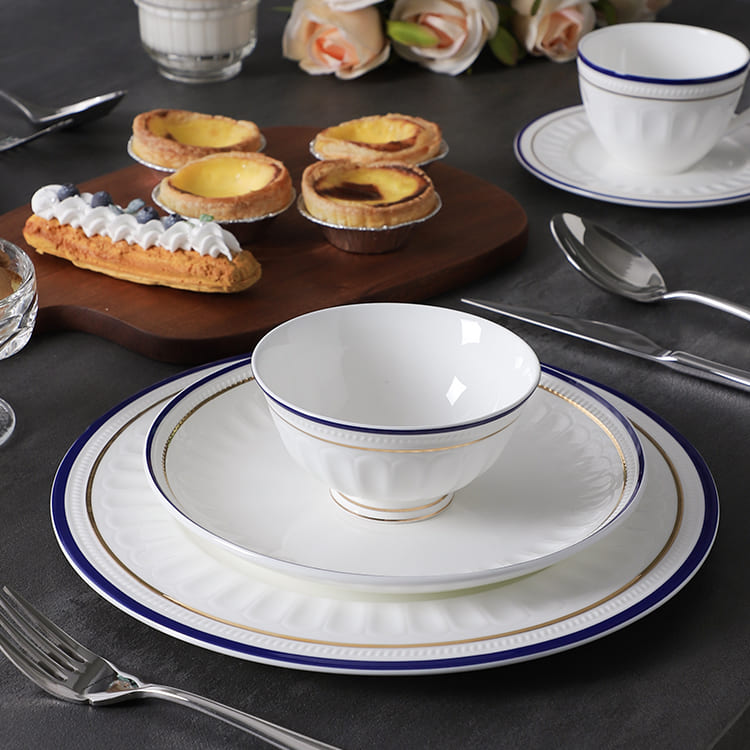
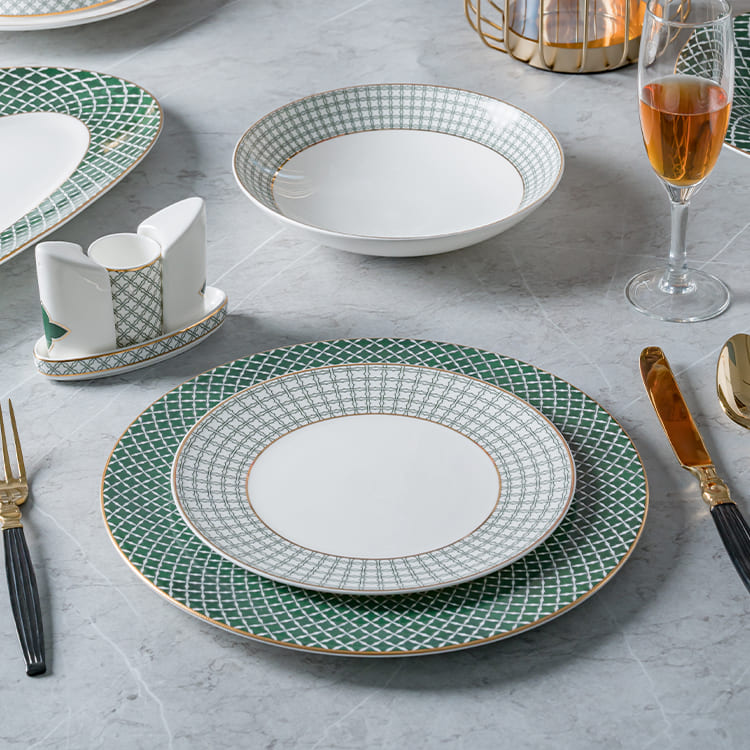
A complete restaurant dinnerware set includes not only plates, but also bowls, serving dishes, and complementary tableware components.
Key considerations include:
- Whether the entire collection maintains a consistent visual identity across plates, bowls, and serving pieces
- Whether the set covers the full table structure (plates, bowls, serving dishes)
- Whether it aligns with the restaurant’s overall design concept
- Whether it supports future expansion and replenishment
For hotel groups and chain restaurants, consistency across locations is critical. Even minor variations in glaze tone, plate dimensions, or rim design can affect table presentation and weaken brand identity.
Long-Term Value vs Initial Purchase Cost
When selecting wholesale restaurant dishes, procurement decisions should not be based solely on unit price, but on total lifecycle cost:
- Product lifespan
- Breakage and loss rate
- Maintenance and replacement costs
- Long-term supply stability
High-quality restaurant porcelain dinnerware may have a higher initial cost, but it typically offers lower long-term replacement rates, making it more cost-effective over time.
Brand Presentation in Restaurant Tableware
In modern hospitality, restaurant tableware has become an important medium for brand expression.
Especially in high-end dining and hotel environments:
- Tableware design must align with interior aesthetics
- Color, glaze, and form can reinforce brand identity
- Custom design capabilities are often required
This is why more restaurants choose suppliers with strong design and development capabilities, rather than relying solely on standardized manufacturers.
Restaurant Dinnerware Materials: How to Choose the Right Material
In commercial foodservice environments, restaurant dinnerware materials directly influence not only table presentation, but also durability, operational efficiency, and long-term procurement costs. For hotels, restaurants, and hospitality projects, material selection determines whether tableware can maintain stable performance under high-frequency commercial use.
The current commercial dinnerware market mainly includes porcelain, bone china, stoneware, and other specialized materials, each designed for different service environments and operational requirements.
Porcelain Dinnerware
Porcelain is widely used in the restaurant industry because it offers a balanced combination of durability, clean presentation, and operational stability. High-fired porcelain offers strong chip resistance, low water absorption, and stable glaze performance, making it suitable for intensive commercial use.
It is widely applied in hotels, all-day dining restaurants, and banquet operations due to its versatility and consistency in large-scale service environments.
Key characteristics of porcelain dinnerware:
| Feature | Commercial Value |
| High-temperature firing | Suitable for high-frequency commercial use |
| Smooth surface finish | Enhances food presentation clarity |
| Stable glaze performance | Long-term durability under repeated washing |
| High versatility | Compatible with multiple restaurant concepts |
In the high-end hospitality segment, advanced porcelain collections such as fine porcelain and royal white porcelain are developed to achieve a balance between durability and refined visual presentation. PITO, for example, specializes in developing such hospitality-grade porcelain systems for global restaurant and hotel applications.
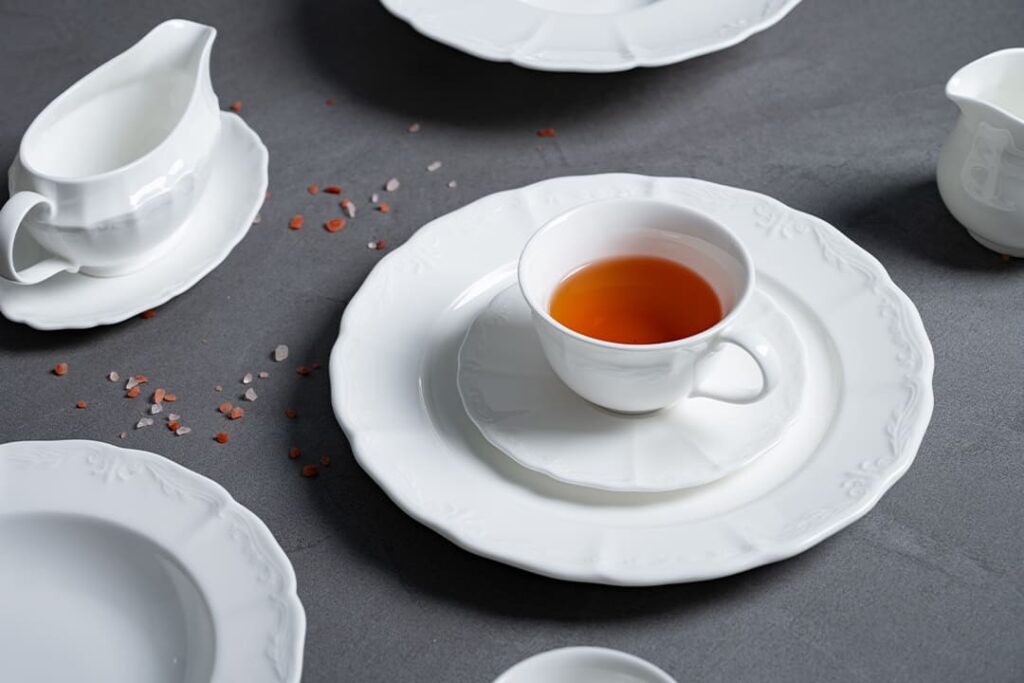
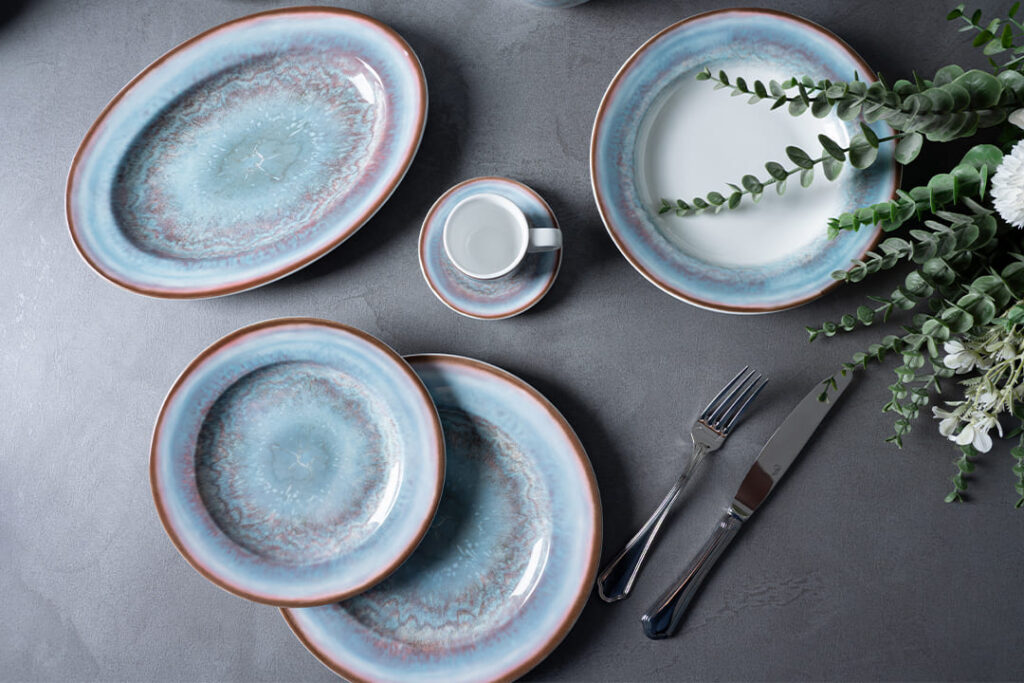
For example, modern fine porcelain focuses on a cleaner and more contemporary table aesthetic, making it suitable for modern dining concepts and boutique hospitality spaces. Royal white porcelain, on the other hand, emphasizes brightness, purity, and presentation clarity, making it widely used in fine dining and upscale restaurants and luxury hotel environments.
These advanced porcelain systems are widely adopted in modern restaurant tableware because they successfully combine commercial performance with design-driven presentation.
Bone China
Modern bone china is commonly used in luxury hospitality environments where both elegance and lightweight handling are important. Many luxury hotels and restaurants adopt bone china for banquet service and premium dining experiences due to its lightweight structure and refined visual appearance.
Compared with standard porcelain, bone china offers:
- Lighter weight for easier handling in service operations
- Higher translucency and visual refinement
- More delicate surface texture
- Stronger perception of luxury and premium quality
Bone china is particularly suitable for environments where table presentation plays a critical role in shaping guest experience. Within high-end restaurant dinnerware systems, it is often used to reinforce brand positioning and elevate overall dining aesthetics while maintaining practical usability.
Stoneware
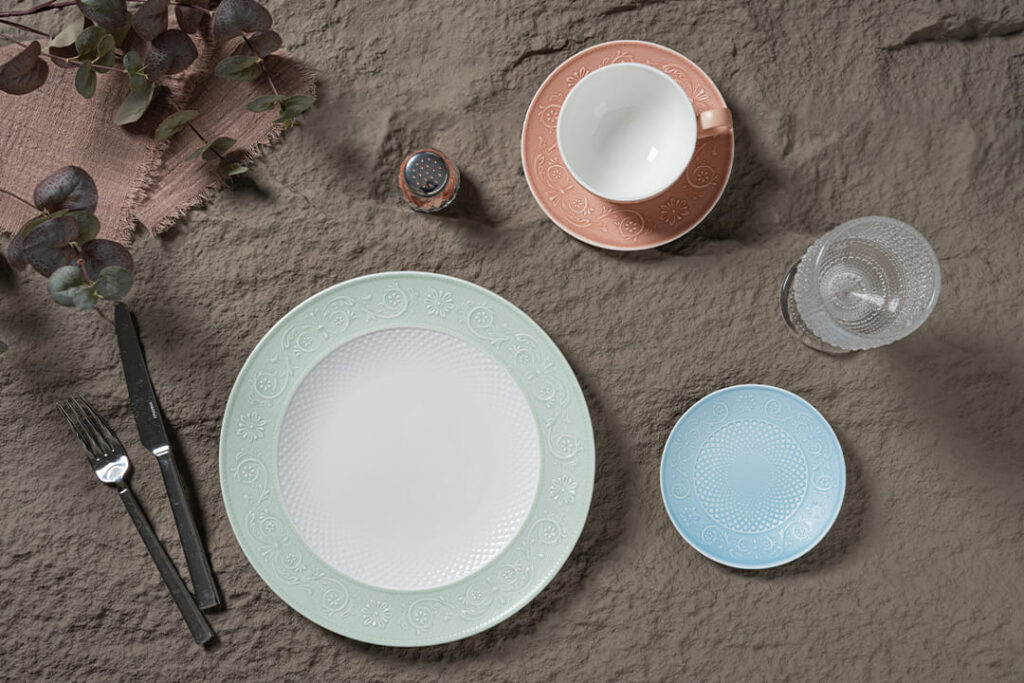
With the rise of experiential dining and natural design concepts, stoneware dinnerware has become increasingly popular in contemporary restaurant environments.
Compared to porcelain, stoneware emphasizes:
- A heavier and more grounded tactile experience
- A handcrafted and artisanal appearance
- Rich glaze variation and texture expression
- Strong alignment with natural or rustic dining concepts
Stoneware is commonly used in concept restaurants, cafés, and creative dining spaces where visual storytelling and atmosphere play an important role in the overall dining experience.
However, in large-scale commercial dinnerware operations, stoneware tends to be heavier, and can result in higher logistics costs and slightly higher breakage-related operational considerations.
Comparison of Common Restaurant Dinnerware Materials
| Material | Appearance | Durability | Weight | Typical Applications |
| Porcelain | Clean & versatile | High | Medium | Hotels, restaurants, daily service |
| Bone China | Elegant & refined | High | Light | Luxury dining, fine dining restaurants |
| Stoneware | Textured & artisanal | Medium | Heavy | Concept restaurants, cafés |
| Melamine | Practical & impact-resistant | Very high | Light | Casual dining, outdoor service |
| Glass | Simple | Medium | Light | Fast service restaurants |
Choosing the Right Material for Restaurant Use
When selecting restaurant tableware materials, the key consideration is not only visual appearance, but also alignment with real operational requirements.
Different restaurant types typically require different material strategies:
| Restaurant Type | Recommended Materials |
| Fine Dining & Luxury Hospitality | Porcelain / Bone China |
| Casual Dining Restaurants | Porcelain / Stoneware |
| Fast Service Restaurants | Melamine / Glass |
Beyond restaurant positioning, usage frequency is another critical factor in commercial dinnerware selection. High-frequency environments typically prioritize:
- Resistance to chipping and breakage
- Dishwasher compatibility under repeated cycles
- Long-term performance stability
In addition, material selection directly affects food presentation. For example, white porcelain dinnerware enhances color contrast and plating clarity, making it widely used in fine dining restaurants and hotel operations.
In practical procurement scenarios, professional restaurant dinnerware wholesale decisions require balancing aesthetics, commercial durability, operational efficiency, and long-term value rather than focusing solely on unit cost.
Plates for Restaurants: Types and Functional Use
In restaurant operations, restaurant plates are among the most frequently used and essential tableware items. Whether for everyday dining, banquet service, or fine dining experiences, plates not only serve a functional role in food presentation, but also directly influence the overall dining atmosphere and guest perception.
For this reason, understanding the functional differences and usage scenarios of various plate types is an important part of professional restaurant plates wholesale planning.
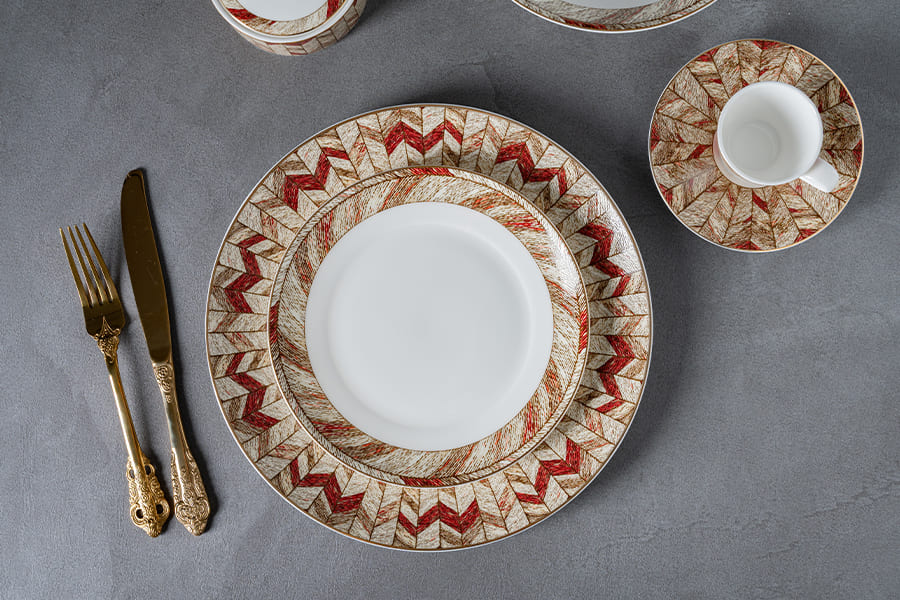
Dinner Plates
Dinner plates are the most frequently used items in restaurant operations and are mainly used for serving main courses.
In most commercial dining operations, standard dinner plates typically range from 10 to 12 inches and are used for meat dishes, pasta, seafood, and other main-course presentations.
Key requirements for commercial dinner plates include:
- Strong structural durability for high-frequency use
- Stable stacking for efficient storage and service handling
- Compatibility with commercial dishwashing systems
- Balanced proportions for modern plating presentation
Within professional commercial dinnerware systems, dinner plates are usually the highest-volume purchasing category due to their daily operational importance.
Side Plates & Salad Plates
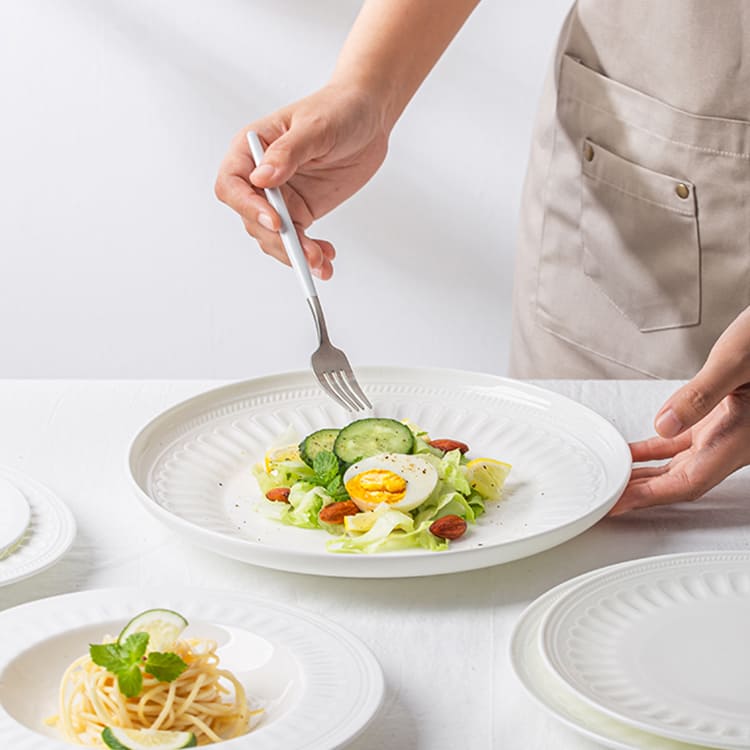
Side plates and salad plates are commonly used for appetizers, desserts, bread service, and smaller portions.
Compared with dinner plates, these smaller formats help create better pacing and layering within multi-course dining experiences.
In modern restaurant operations, they are often used to:
- Improve table composition and visual balance
- Separate course structures more clearly
- Enhance flexibility in food presentation
- Support fine dining and Western-style service formats
As part of a complete restaurant tableware, these supporting plate formats play an important role in creating a more refined dining flow.
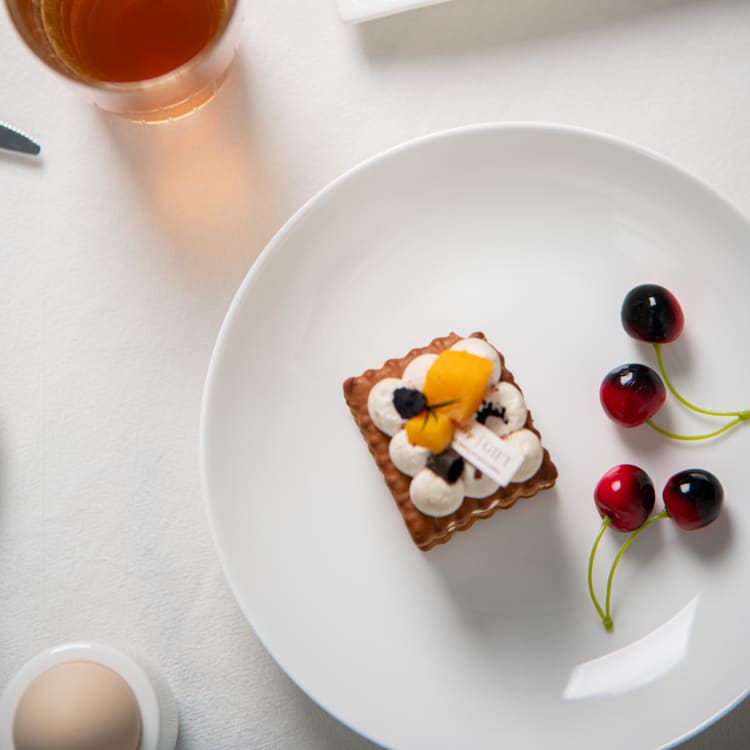
Appetizer & Dessert Plates
In luxury hospitality environments, dedicated appetizer plates and dessert plates are commonly used to elevate presentation standards.
These smaller plate formats are designed to:
- Highlight plating precision and detail
- Control portion presentation visually
- Create rhythm within multi-course dining experiences
- Support elegant table transitions between courses
Compared with standard commercial plates, these pieces often place greater emphasis on refined proportions, delicate rim design, and visual presentation balance.
Charger Plates
Charger plates are frequently used in banquet service, luxury hospitality, and fine dining table settings.
Unlike functional serving plates, charger plates are primarily designed to enhance overall table presentation rather than directly hold food.
Their main functions include:
- Creating a visual foundation for table settings
- Enhancing layering and presentation depth
- Reinforcing formality and luxury atmosphere
- Supporting premium banquet and hospitality experiences
Within high-end commercial tableware, charger plates are often used to strengthen the overall visual identity of the dining environment.
Functional Use in Restaurant Operations
From an operational perspective, different types of restaurant plates must support both presentation and workflow efficiency.
Professional restaurant tableware systems typically prioritize:
- Efficient service flow and plating speed
- Easy stacking and storage management
- Durability under high-frequency commercial use
- Compatibility with dishwashing operations
- Consistent visual presentation across the dining experience
In modern hospitality environments, restaurant plates are no longer viewed simply as serving tools. Instead, they function as an integrated part of the restaurant’s operational system, visual presentation strategy, and overall guest experience.
Fine Dining Dinnerware: Standards for High-End Restaurants
In fine dining environments, dinnerware is considered part of the overall dining experience rather than just a functional tool. Instead, it becomes part of the overall dining experience, brand identity, and presentation philosophy.
Compared with standard commercial dining operations, high-end restaurants place greater emphasis on refined consistency, including material quality, proportions, detailing, and visual harmony across the entire table setting.
As a result, high-end hospitality tableware is typically selected with one primary objective: enhancing the presentation of the food itself rather than competing visually with the cuisine.
Material & Finish: Porcelain and Bone China as Core Choices
Within high-end hospitality environments, the most widely used fine dining dinnerware materials remain porcelain and bone china.
Among them:
- Fine porcelain emphasizes clean lines, refined structure, and modern table aesthetics, making it especially suitable for contemporary fine dining and boutique hospitality environments
- Bone china offers a lighter body, higher translucency, and a more delicate visual texture, commonly used in luxury hospitality and premium dining experiences
These materials are valued not only for their elegance, but also for their ability to maintain professional presentation standards in commercial service environments.
Design Minimalism and Plate Proportions
In fine dining, tableware design typically follows a core principle: The focus should always remain on the food, not the tableware.
For this reason, high-end restaurants often prefer:
- Minimal and clean plate designs
- Precise plate-to-food proportions
- Neutral color systems such as white or soft natural tones
- Shapes that create visual focus without overwhelming the dish
For example, wide-rim porcelain plates are commonly used in fine dining because they help frame the food presentation while maintaining visual balance and elegance.
Similarly, white porcelain dinnerware remains highly popular in luxury dining because it enhances ingredient colors and plating detail without introducing unnecessary visual distraction.
Consistency and Table Setting Standards
In professional hospitality environments, restaurant tableware consistency is considered an essential standard.
This includes:
- Consistent glaze tones across the entire collection
- Unified design language between different pieces
- Stable color consistency in long-term replenishment orders
- Balanced visual coordination across the table setting
For luxury hotels and upscale restaurant groups, even small inconsistencies in tableware can affect brand perception and overall dining presentation.
Functionality Behind Elegance
Although premium dining spaces strong emphasis on aesthetics, the functional performance of commercial dinnerware remains equally important.
Professional fine dining tableware must still support:
- Commercial durability during service
- Compatibility with high-frequency dishwashing
- Efficient plating and food service operations
- Stable handling performance in kitchen environments
Truly professional fine dining dinnerware achieves a balance between visual elegance and commercial practicality, allowing restaurants to maintain both operational efficiency and refined guest experiences.
How to Choose a Reliable Restaurant Tableware Supplier
Selecting the right restaurant tableware supplier is one of the most important decisions in commercial dinnerware procurement. Beyond product appearance, professional buyers must evaluate manufacturing stability, quality standards, supply consistency, and long-term cooperation capability.
For hotels, restaurant groups, and hospitality projects, a reliable supplier is not simply a manufacturer, but a long-term operational partner capable of supporting both business performance and brand presentation.
Manufacturing Capability and Product Range
A professional commercial dinnerware supplier must demonstrate stable production capability, consistent quality control, and long-term supply reliability.
Key evaluation factors typically include:
- Bulk production capacity for large-scale projects
- Complete restaurant dinnerware collections covering plates, bowls, serving ware, and accessories
- Consistency between production batches, including glaze tone and shape accuracy
- Strict quality control systems throughout manufacturing
- Availability of multiple material options such as porcelain, bone china, and stoneware
- Ability to support continuous replenishment and long-term supply programs
- Stable delivery capability for international hospitality projects
For hotel groups and chain restaurant operations, supply stability is often more important than short-term pricing advantages. Inconsistent quality or unstable replenishment capability can directly affect operational efficiency and brand consistency across locations.
Quality Certifications and Compliance Standards
For international hospitality procurement, quality certifications are an important indicator of manufacturing reliability and product safety.
Professional restaurant tableware suppliers are typically expected to comply with international standards such as:
| Certification | Purpose |
| FDA | Compliance with U.S. food-contact safety regulations |
| LFGB | German and European food safety testing standards |
| Prop 65 | California compliance requirements for restricted substances |
| ISO | Quality management and manufacturing system standards |
These certifications are essential for ensuring food safety compliance and meeting international hospitality procurement standards.
For global hospitality projects, certified manufacturing standards are often essential for procurement approval and long-term operational confidence.
Customization Capability for Brand Identity
In modern hospitality environments, tableware is increasingly viewed as part of the restaurant’s visual identity rather than simply a functional product.
As a result, the supplier’s custom restaurant tableware capability has become an important consideration for premium restaurants and hotels.
Customization capabilities may include:
- Logo application and branding integration
- Custom glaze colors and surface finishes
- Bespoke shapes and structural development
- Full collection customization for hospitality projects
Suppliers with in-house design and product development capabilities are generally better suited for long-term brand collaborations, especially for restaurants and hotels seeking differentiated dining experiences.
For example, manufacturers with dedicated R&D teams and strong design resources are often able to support both aesthetic development and commercial functionality simultaneously. In the hospitality industry, this combination is increasingly important for brands aiming to create consistent and recognizable table presentation systems.
Long-Term Partnership and Supply Stability
Beyond product quality, professional hospitality buyers increasingly prioritize long-term partnership capability when selecting a supplier.
A reliable restaurant tableware partner should be able to support:
- Long-term replenishment consistency
- Stable lead times for repeat orders
- Ongoing product development cooperation
- International logistics and export experience
- Flexible support for hospitality projects and large-volume procurement
In large-scale hospitality operations, restaurant tableware is not a one-time purchase, but part of a continuous operational system. Choosing a supplier with stable manufacturing capability, strong quality control, and long-term collaboration experience can significantly improve procurement efficiency and reduce operational risk over time.
PITO: Hospitality Tableware Designed for Modern Dining Environments
Originating from Chaozhou, China’s renowned “Porcelain Capital,” PITO is a hospitality-focused ceramic manufacturer from Chaozhou, specializing in commercial-grade tableware systems for hotels, premium restaurants, and global hospitality projects.
PITO combines advanced manufacturing capability with the heritage of traditional Chaozhou porcelain craftsmanship.
Hospitality-Focused Tableware Development
Modern hospitality environments require tableware that balances visual refinement with operational performance. From upscale restaurants to large-scale hotel service, tableware must support daily efficiency, long-term durability, and consistent presentation standards.
PITO develops hospitality-focused porcelain and bone china collections designed specifically for high-frequency commercial use. Each collection is created to support both dining aesthetics and operational practicality across hotels, restaurants, and banquet environments.
PITO’s high-strength bone china, containing up to 52% bone ash, offers a lightweight appearance while maintaining strong durability for hospitality operations.
Designed for Long-Term Consistency
For hospitality brands operating across multiple locations, consistency is critical — not only in design, but also in replenishment, glaze stability, and long-term supply coordination.
PITO’s production systems are structured to support these operational requirements through stable glaze control, dimensional consistency, and long-term replenishment capability.
This experience has been developed through participation in international hospitality and government banquet projects, where even small variations in tabletop presentation can affect brand perception and dining standards.
Supporting Global Hospitality Projects
PITO has experience supporting a range of hospitality environments, including luxury hotels, restaurants, government banquet projects, and international hospitality groups.
Projects such as Dubai EMAAR Hospitality Group, Qatar Fairmont Hotel, IHG – Saudi Arabia, Address Beach Resort -UAE, have contributed to PITO’s understanding of large-scale dining operations and premium tabletop presentation standards.
Rather than focusing solely on product manufacturing, PITO approaches hospitality tableware as part of the overall dining experience and operational system.
Tableware Design for Hospitality Concepts
In modern hospitality environments, tableware is no longer viewed simply as a functional dining product. It has become part of the overall dining atmosphere, culinary presentation, and guest experience.
Different hospitality concepts often require different tabletop approaches. Premium dining environments may prioritize minimalist aesthetics and refined plating presentation, while hotel banquet environments typically require coordinated tableware systems capable of maintaining visual consistency across large-scale service operations.
Rather than approaching customization as simple decorative modification, PITO works with hospitality brands to develop tableware collections aligned with specific dining concepts, service styles, and presentation requirements.
Supported by extensive design resources and hospitality project experience, PITO provides customized tabletop solutions including glaze development, shape coordination, color systems, and complete collection planning for hotels, restaurants, banquet venues, and premium hospitality spaces.
For many hospitality brands, tableware is not only part of the dining table, but also part of the brand’s visual identity and overall dining experience. This is especially important in luxury hospitality environments where tabletop presentation directly influences guest perception.
PITO’s experience across international hospitality and banquet projects has contributed to its understanding of how tabletop systems must balance aesthetics, operational practicality, and long-term consistency within real hospitality environments.
Conclusion
Restaurant dinnerware wholesale involves far more than selecting visually appealing products. For modern hospitality environments, material durability, operational consistency, tabletop presentation, and long-term supply stability all play an important role in the procurement process.
For restaurants operations, choosing the right commercial tableware supplier can help support both dining presentation and long-term operational performance.
With experience supporting international hospitality environments, PITO provides hospitality-focused tableware solutions designed to balance dining presentation, operational performance, and long-term consistency for modern hotels, restaurants, and banquet projects worldwide.
FAQ
Is bone china suitable for hotel and restaurant operations?
Modern hospitality-grade bone china is widely used in luxury hospitality environments because it combines lightweight handling, refined presentation, and strong durability for commercial service conditions.
Why do restaurants need commercial-grade dinnerware instead of household tableware?
Commercial dinnerware is specifically engineered for high-frequency use in hospitality environments such as hotels and restaurants. Compared to household tableware, it offers significantly higher durability, improved resistance to chipping, and stable performance under repeated dishwasher and heavy-use conditions.
In addition, commercial tableware systems are designed to support bulk replacement and long-term operational consistency, which is essential for restaurant and hotel operations.
Why is white porcelain commonly used in hospitality dining environments?
White porcelain dinnerware enhances food color contrast and plating visibility, making it easier to create clean and refined culinary presentation across different dining concepts.
Can restaurant tableware be customized?
Yes. Many professional suppliers offer custom restaurant tableware solutions, including logo application, custom glaze colors, and shape development.
Customization is especially common in hotel groups, restaurant chains, and branded dining concepts that require consistent visual identity across multiple locations. Advanced manufacturers may also provide full collection development to support complete restaurant tableware system design.
How often should restaurant tableware be replaced?
Replacement cycles depend on usage intensity, material quality, and operational conditions. High-quality commercial dinnerware can typically last several years under proper maintenance and handling.
However, frequently used items such as restaurant plates may require periodic replacement due to edge chipping, glaze wear, or design updates to maintain presentation standards.
What should hospitality buyers consider when choosing a dinnerware supplier?
Beyond product appearance, hospitality buyers typically evaluate long-term supply stability, replenishment consistency, commercial durability, customization capability, and experience supporting hospitality operations.
How durable is commercial porcelain dinnerware?
High-quality commercial porcelain dinnerware is designed to withstand intensive hospitality use, including frequent washing, stacking, and high-temperature exposure.
Its durability depends on factors such as firing temperature, material composition, and glaze quality. Premium porcelain products are engineered to maintain structural stability and surface integrity over long-term commercial use, making them suitable for hotels, restaurants, and banquet operations.