High-temperature fired porcelain with an intact glaze and no metallic decoration is generally microwave safe and dishwasher safe. However, safety depends on firing temperature, glaze quality, structural integrity, and intended usage environment.
For hospitality professionals, understanding porcelain safety is not just about appliance compatibility — it directly impacts operational efficiency, replacement costs, and brand presentation.
Is Porcelain Microwave Safe?
Yes — most high-quality porcelain is microwave safe, provided it contains no metallic decoration and is properly fired at high temperature.
Microwaves heat food by exciting water molecules. Well-manufactured porcelain has a dense, low-absorption structure, meaning it does not absorb microwave energy itself.
However, not all porcelain is equal. Manufacturing quality determines safety.
Porcelain is generally microwave safe if:
- Fired above 1250–1300°C
- Fully vitrified with low water absorption
- Free of gold, silver, or metallic trims
- Free from cracks or glaze crazing
If sparking or overheating occurs, discontinue use immediately.
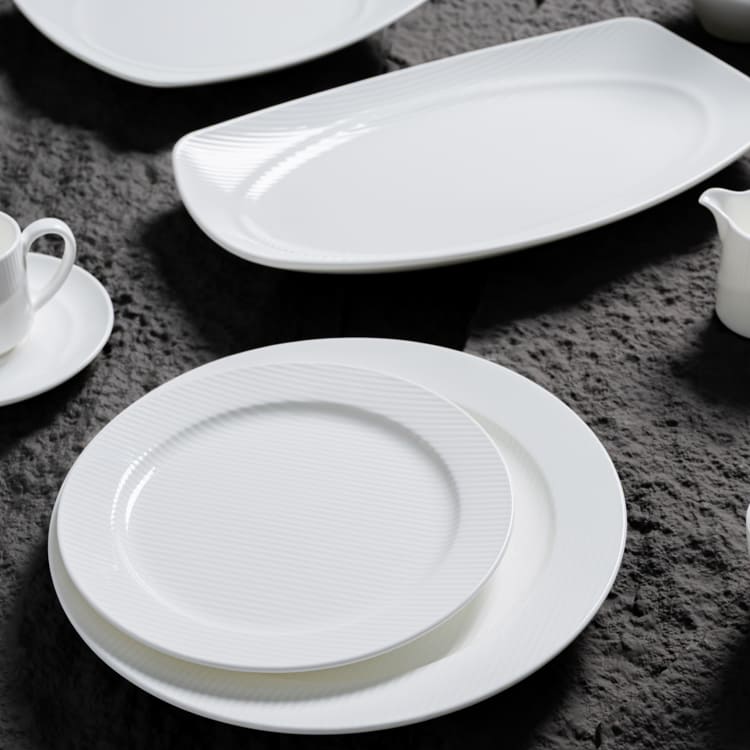
When Porcelain Is NOT Microwave Safe
Microwaves do not directly damage porcelain — they expose weaknesses in poor manufacturing.
- Metallic Trim: Gold or silver rims reflect microwave energy, causing sparks (arcing).
- Never microwave porcelain with metal decoration.
- Low Firing Temperature: Under-fired porcelain retains moisture in its body. Trapped moisture heats rapidly and can cause overheating or cracking.
- High Water Absorption: Porcelain with higher porosity absorbs microwave energy and becomes excessively hot.
- Cracks or Glaze Damage: Micro-cracks allow moisture penetration, increasing heating risk and structural weakness.
If sparking, overheating, or unusual noise occurs, discontinue use immediately.
Is Porcelain Dishwasher Safe?
Yes — Most porcelain dinnerware is dishwasher safe, especially when manufactured for commercial or hospitality use.
Dishwashers expose tableware to:
- High water temperatures (above 1280°C)
- Rapid temperature changes
- Strong spray pressure
- Alkaline detergents
High-temperature porcelain withstands this due to its strong glaze bonding and thermal shock resistance.
Factors affecting dishwasher durability:
- Glaze quality
- Firing temperature
- Water absorption rate
- Frequency of use
Household porcelain may perform well at home but degrade faster in commercial kitchens.
How to Test Porcelain Microwave Safety
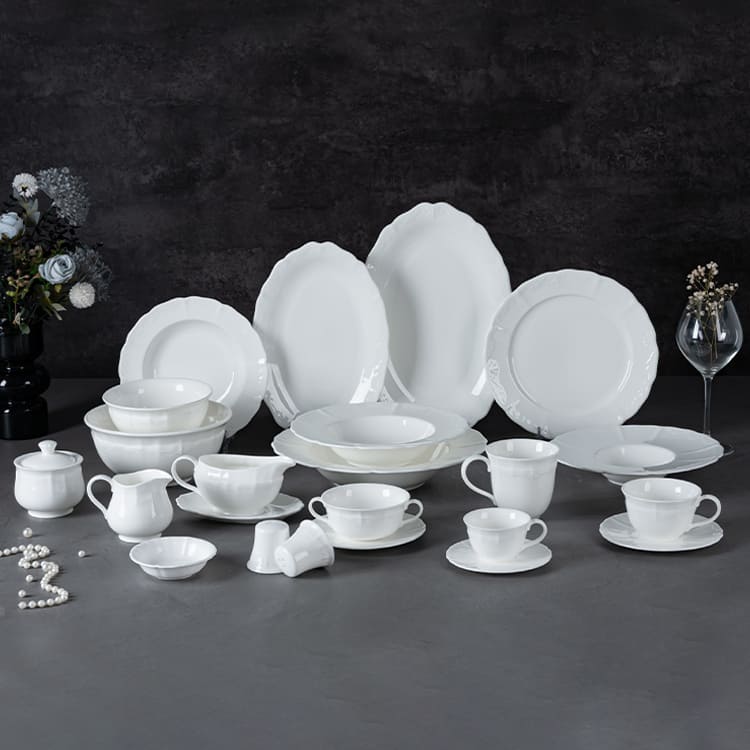
While comprehensive safety testing should always be conducted by manufacturers, understanding basic evaluation methods can help with day-to-day judgment. It is important to note that for commercial procurement, products with verified certifications and clearly stated safety ratings should always be prioritized over on-site testing.
The 30-Second Microwave Water Test (Reference Only)
This simple test is commonly used in household settings and small foodservice operations as a preliminary check for microwave suitability.
Test Procedure:
- Place the porcelain item in the microwave.
- Put a cup of room-temperature water (approximately 250 ml) inside or next to the porcelain.
- Heat at medium to high power (600–800W) for about 30 seconds.
Carefully remove the item and touch the porcelain surface (use caution to avoid burns).
How to Interpret the Results:
- Water is hot, porcelain is warm or near room temperature: The porcelain is generally considered microwave safe.
- Porcelain is significantly hotter than the water: The porcelain body is absorbing microwave energy and is not recommended for continued microwave use.
- Sparks, unusual noises, or arcing occur: Stop immediately. The porcelain must never be used in a microwave.
Professional Recommendation:
Household tests should be viewed as informational only. For hotels, restaurants, and other high-frequency commercial environments, long-term safety and durability depend on professionally tested, certified porcelain with clearly defined usage specifications.
For this reason, hospitality professionals are advised to select commercial-grade porcelain from specialized suppliers such as PITO, where standardized testing and clear safety labeling ensure consistent performance, operational reliability, and extended service life.
Why Some Porcelain Gets Damaged in Microwaves or Dishwashers
Porcelain failure usually results from manufacturing quality differences, not from the appliances themselves.
- Low Firing Temperature:
Porcelain fired at insufficient temperatures may retain moisture within the body. In microwaves, this trapped moisture heats rapidly, causing overheating or cracking.
- Metallic Decoration:
Gold or silver trims reflect microwave energy, creating sparks or arcing. These items should never be microwaved.
- Glaze Erosion in Dishwashers:
Repeated exposure to strong detergents may dull inferior glazes over time.
- Thermal Shock:
Sudden temperature changes — such as placing refrigerated porcelain directly into a microwave — can cause structural stress.
Even high-quality porcelain can crack under extreme temperature shifts.
Porcelain vs Ceramic vs Other Materials: Which Is Safer?
High-temperature porcelain and bone china are the better choices for microwave and dishwasher use in both home and commercial kitchens. Other materials—such as low-temperature ceramics, stoneware, glass, melamine, and stainless steel—have limitations that make them less suitable for high-frequency hospitality operations.
Understanding how different materials perform under microwave and dishwasher conditions helps hospitality professionals make informed purchasing decisions and maintain safe, durable tableware.
| Material | Microwave Safe | Dishwasher Safe | Best For |
| High-Temperature Porcelain | Yes | Yes | Hotels, restaurants, daily use |
| Bone China | Yes | Yes | Fine dining, banquets |
| Low-Temp Ceramic | Depends | Limited | Light home use |
| Stoneware | Often | Varies | Medium |
| Glass | Yes | Yes | Casual dining |
| Melamine | No | Yes | Outdoor / buffet |
| Stainless Steel | No | Yes | Commercial prep |
High-temperature porcelain offers the best balance of safety, durability, and professional presentation.
High-Temperature Porcelain: Microwave and Dishwasher Safe
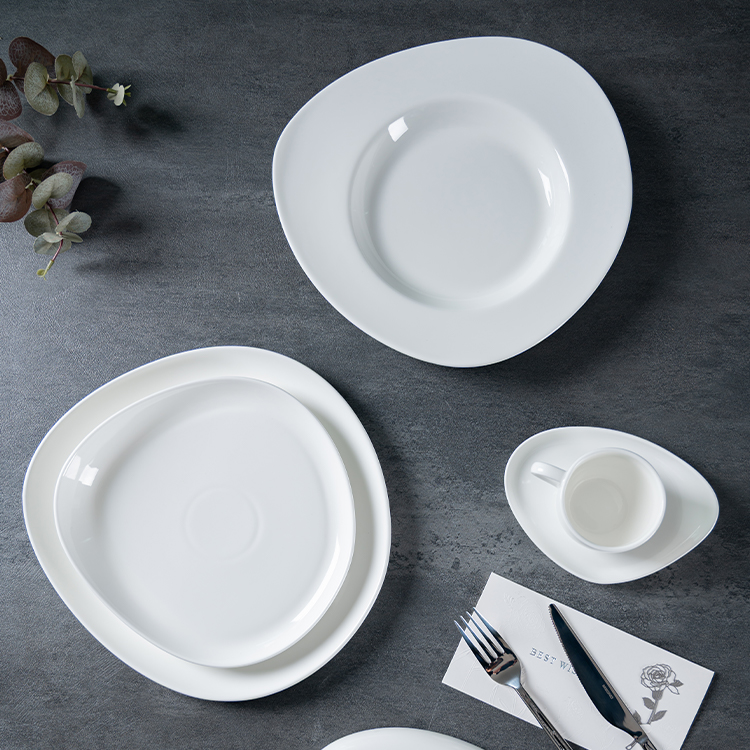
High-quality, high-temperature porcelain is fired at 1320°C, resulting in a dense, non-porous structure that resists thermal shock and maintains integrity through repeated heating and washing cycles. Its chemically stable glaze prevents substances from migrating into food, even under high heat.
Key Characteristics:
- Microwave: Safe (when free of metallic decoration)
- Dishwasher: Safe
- Thermal Stability: Excellent; low water absorption, minimal heat retention
- Commercial Suitability: Can withstand hundreds of commercial dishwasher cycles while maintaining an elegant appearance
Industry Note: Commercial-grade porcelain, such as those supplied by leading brands, offers reliability for high-frequency hotel and restaurant operations.
Bone China
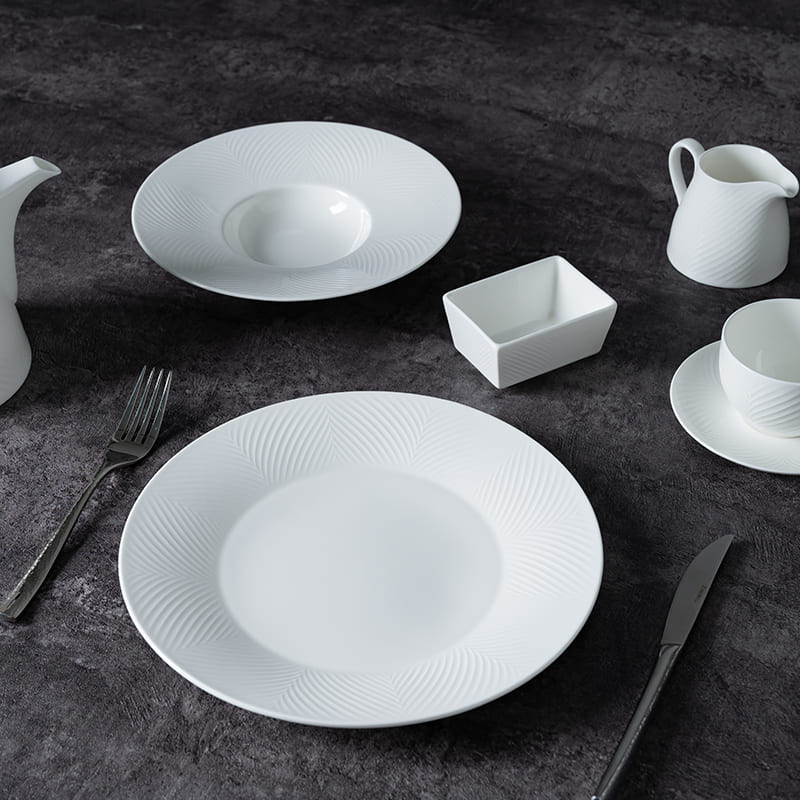
Bone china is known for its lightness, translucency, and refined texture, making it a preferred choice for premium dining environments. PITO bone china dinnerware contains at least 45% bone ash, combining visual delicacy with enhanced strength.
Key Characteristics:
- Microwave: Safe (without metallic decoration)
- Dishwasher: Safe
- Weight & Heat Transfer: Lightweight with faster heat transfer
- Thermal Stability: Bone ash content improves resistance to thermal shock
When manufactured to the same standards, bone china offers reliable safety and performance, making it suitable for fine dining, banquets, and luxury hospitality settings.
Ceramic
In the dinnerware industry, “ceramic” often refers to low-temperature fired ceramics.
Key Characteristics:
- Microwave: Depends on firing temperature
- Dishwasher: Limited long-term stability
- Water Absorption: Relatively high; prone to overheating or cracking
- Commercial Suitability: Not recommended for high-frequency use
In the porcelain vs ceramic comparison, high-temperature porcelain is generally more suitable for microwave and dishwasher use due to its denser structure. For commercial operations, porcelain should always be prioritized.
Stoneware: Durable but Less Suitable for High-Frequency Use
Stoneware is thick and heavy, with a rustic aesthetic. Its density provides good heat retention but uneven heating and repeated dishwasher cycles may affect glaze quality over time.
Key Characteristics:
- Microwave: Often usable, performance varies with thickness.
- Dishwasher: Long-term use may reduce glaze quality.
- Heat Retention: Good insulation but less even heating.
- Commercial Suitability: Better for slow dining or casual service rather than rapid reheating and frequent dishwashing.
Glass Dinnerware: Heat Resistant but Less Durable
Borosilicate and tempered glass resist thermal shock and perform well in microwaves. However, glass lacks porcelain’s insulating properties and is prone to chipping, especially in commercial dishwashers.
Key Characteristics:
- Microwave: Safe
- Dishwasher: Safe, but edges may chip
- Commercial Suitability: Less durable for high-volume operations
Melamine: Dishwasher Safe but Never Microwave
Melamine is lightweight, impact-resistant, and fully dishwasher safe, making it popular in casual or outdoor dining.
Key Characteristics:
- Microwave: Not safe
- Dishwasher: Safe
- Limitations: May warp, discolor, or release harmful substances under heat
- Commercial Suitability: Suitable for casual dining or buffet settings, but not for reheating
Stainless Steel: Durable but Microwave Unsafe
Stainless steel is extremely durable and fully dishwasher safe. However, due to its metallic nature, it cannot be microwaved.
Key Characteristics:
- Microwave: Not safe
- Dishwasher: Safe
- Commercial Suitability: Best for buffet service or specialized applications, not comprehensive tableware
Why Porcelain Remains the Preferred Choice for Hospitality
For hotel procurement managers and restaurant owners, the comparison clearly explains why porcelain remains the optimal material for restaurants and hotels:
| Core Advantage | Commercial Value |
| Dual compatibility | Safe for both microwave and dishwasher use, reducing sorting complexity |
| Long-term economy | Higher initial investment offset by extended service life |
| Food safety | Non-reactive glaze prevents food contamination |
| Brand image | Maintains refined appearance through thousands of use cycles |
| Versatile application | Suitable for casual dining through fine dining |
| Supply stability | Professional suppliers ensure consistent replenishment |
Tips for Safely Using Porcelain in the Microwave and Dishwasher
Whether for home use or commercial kitchens, porcelain dinnerware safety depends not only on material quality but also on proper handling and usage practices. Following a few essential principles can significantly reduce breakage risk and extend the service life of porcelain dinnerware—especially in high-frequency hospitality environments.
Prevent Thermal Shock in Microwave and Dishwasher Use
Porcelain is heat-resistant but sensitive to sudden temperature changes. Thermal shock is one of the leading causes of hidden structural damage in commercial kitchens.
Best Practices:
- Do not place refrigerated or frozen porcelain directly into a microwave.
- After microwave heating, avoid immediate contact with cold water or cold surfaces.
- After dishwashing, allow porcelain to cool naturally before handling.
Tip: Even high-quality microwave safe porcelain can crack if exposed to extreme temperature changes.
Do Not Microwave Empty Porcelain
Microwaving empty or nearly empty porcelain concentrates energy on the dinnerware itself rather than on food or liquid.
Correct Use:
- Ensure porcelain always contains food or liquid during microwave heating.
- Never heat empty bowls, plates, or cups.
- During testing or preheating, place a cup of water in the microwave as a buffer.
This risk is particularly common in household use but can also occur during busy service periods if procedures are not standardized.
Use Staged Heating for Better Stability
Continuous high-power microwave heating can lead to uneven temperature distribution and localized overheating.
Recommended Approach:
- Use medium power settings
- Heat in stages, pausing to stir or check between intervals
- Especially suitable for soups, sauces, and high-moisture foods
Staged heating not only improves safety but also ensures more even food temperatures.
Monitor for Cracks or Damage
Even minor cracks or glaze crazing of porcelain dinnerware can compromise microwave and dishwasher safety.
Inspection Guidelines:
- Inspect porcelain tableware regularly in high-frequency settings.
- Remove any damaged items from service immediately.
- Prefer certified commercial-grade porcelain designed for both microwave and dishwasher use.
Industry Insight: Suppliers of commercial-grade porcelain, such as PITO, provide certified products with clearly defined usage specifications, helping kitchens maintain safe and consistent performance.
Common Risks and How to Avoid Them
| Common Risk | Cause | How to Avoid |
| Sudden cracking | Excessive temperature change | Gradual heating and cooling |
| Microwave sparks | Metallic decoration | Avoid microwaving; choose plain glazed porcelain |
| Glaze dulling | Prolonged high-temperature dishwashing | Use commercial-grade porcelain |
| Porcelain overheating | Microwave energy absorption | Discontinue use and replace |
| Reduced service life | Improper high-frequency handling | Staff training; quality procurement |
Professional Insight: For restaurants, hotels, and other high-usage environments, selecting porcelain specifically engineered for commercial applications is far more effective than relying on post-use risk avoidance.
FAQ: Microwave and Dishwasher Safety for Porcelain Dinnerware
A: No. Not all porcelain is suitable for microwave and dishwasher use.
In general, high-temperature fired porcelain with an intact glaze and no metallic decoration is considered safe for both microwaves and dishwashers.
A: Porcelain itself is not directly heated by microwaves. However, if the ceramic body has high water absorption, insufficient firing, or micro-cracks, moisture inside the porcelain may absorb microwave energy and cause the dinnerware to heat up.
A: Yes, if designed for commercial hospitality use. High-frequency hotel and restaurant environments require porcelain with strong thermal resistance and durability. Certified commercial-grade porcelain can withstand thousands of dishwasher cycles without cracking or fading. Household-grade porcelain may deteriorate quickly under these conditions.
A: Most high-quality fine porcelain and bone china are safe to use in modern dishwashers. However, items with metal edges are not recommended for use in dishwashers as they can be damaged.
A: High-quality commercial porcelain is completely safe and does not release harmful substances when heated. It complies with FDA, EU, and international food safety standards.
A: Fine porcelain without metallic decoration is generally microwave safe. Manufacturers typically label microwave and dishwasher suitability for each collection.
Final Thoughts
Microwave and dishwasher safety in porcelain dinnerware is more than a product feature—it reflects smart procurement, operational efficiency, and brand standards in both home and commercial settings.
For hotels, restaurants, and other high-frequency hospitality environments, selecting high-temperature fired porcelain or bone china ensures long-term durability, consistent performance, and safe use under repeated microwave and dishwasher cycles.
Commercial-grade porcelain solutions, such as those supplied by leading brands-PITO, provide certified safety, clearly defined usage specifications, and professional support—helping hospitality professionals achieve operational reliability, staff safety, and long-term cost efficiency.